
Arrest Records in Leelanau County
The Leelanau County Sheriff is the principal local patrol and jail agency, but it is not the only arresting authority. Michigan State Police, Grand Traverse Band Tribal Police, National Park Service rangers, DNR conservation officers, and Traverse City Police within that city’s small Leelanau portion can each create their own report. The badge and report number determine the correct custodian.
An arrest history is a set of events, not one guaranteed county file. The officer creates the narrative. Jail staff create the booking entry. Fingerprints may create a CJIC arrest cycle. District Court creates a case only when a complaint, warrant, or prosecutor filing reaches court. Each channel can contain facts that the others do not.
No Leelanau Arrest Roster
No official public Leelanau County booking log or browser-based jail roster was located. For current custody, call the sheriff and jail at 231-256-8800. MI-VINE offers a separate custody search and optional notifications. A focused county FOIA request is the route for a historical booking sheet or jail record not released by phone.
The official MI-VINE interface shows the available Michigan custody search.

MI-VINE is useful for custody and release updates, but it does not supply a complete past arrest history or the agency narrative.
Leelanau County Arrest Lookups
The best Leelanau arrest search is channel-complete. Start with current custody, then identify the report custodian, court case, and statewide record as needed. Keep the event date, location, arresting agency, full legal name, and report or case number close at hand. A narrow request is faster to identify than “all records about a person.”
Use a legal name and date information to separate similar people, but do not treat a same-name result as fingerprint proof.
- Call the Leelanau jail and use MI-VINE for current custody and release status.
- Ask the arresting agency for its report and the sheriff for its booking record.
- Search MiCOURT after charges are filed, then contact the correct clerk.
- Use ICHAT later for qualifying public Michigan arrest and disposition history.
- Submit an event-specific FOIA request when other channels do not supply the source record.
Leelanau Arrest Record Custodians
Village location does not prove the sheriff made the arrest. Suttons Bay, Northport, and Empire have no independent police departments, so the sheriff is the usual local channel. Yet a state trooper, tribal officer, park ranger, conservation officer, or Traverse City officer may hold the report. The resulting court system can also change.
A state or federal agency report does not move into the sheriff’s files merely because the arrest occurred in Leelanau County.
| Agency | Likely record route |
|---|---|
| Leelanau Sheriff | County FOIA, jail phone, and local court if charged |
| Michigan State Police | MSP records process and originating post |
| Grand Traverse Band Police | Tribal public-safety and court channels |
| NPS ranger | NPS or DOI records and federal court if prosecuted federally |
| DNR officer | Michigan DNR records, then state court if locally charged |
Arrest Records: What They Contain
A Leelanau arrest file can identify the agency report, event time and place, legal basis, alleged offense, transport destination, and booking episode. Narrative, witness, victim, medical, juvenile, or active-investigation information can be redacted. Booking charges reflect intake and may not match what the prosecutor later files.
Read release and bond fields as time-sensitive custody facts. The issuing court remains the authority for current bond terms and warrant status.
| Booking number | The sheriff’s identifier for the intake episode. |
|---|---|
| Booking date and time | When jail intake occurred, which can differ from arrest time. |
| Arresting agency | The office that created and retains its report. |
| Charges | Allegations presented at intake, not necessarily filed charges. |
| Bond | Court-set release amount and conditions when public. |
| Booking photo | Release requires a custodian-specific FOIA and exemption review. |
| Release status | Release, transfer, hold, or current custody information. |
Request Leelanau Booking Records
Use the Leelanau County FOIA form for sheriff-held arrest reports, booking sheets, jail register entries, CAD logs, 911 audio, or body-camera records. Identify the sheriff as the office, give a narrow event date and location, include the incident number when known, and state whether inspection, paper, or electronic delivery is preferred.
Michigan FOIA generally requires a response within five business days and allows one extension of up to ten business days. Leelanau’s FOIA procedures and guidelines explain the county process. A response may be an estimate or partial grant rather than immediate production. Search, review, redaction, duplication, and mailing costs can apply. Ask for an estimate before authorizing large audio or video work.
Note: Requesting a booking photograph does not guarantee release; privacy, juvenile, investigation, and other exemptions require case-specific review.
Recent Leelanau County Bookings
Because Leelanau County has no official public booking log, recent arrest confirmation starts by phone. Ask the jail what current custody information can be released. Register with MI-VINE when release or transfer notification is useful. Selected sheriff news posts are not a full arrest blotter and should never be treated as one.
A person may be released before a court case appears online. A filed case may also appear after the booking record is no longer current. Search the 86th District Court in MiCOURT, but remember that a prosecutor can decline charges or file a different offense. For the whole sequence, compare booking, agency report, court file, and later ICHAT entry.
Leelanau Arrests Reach CJIC
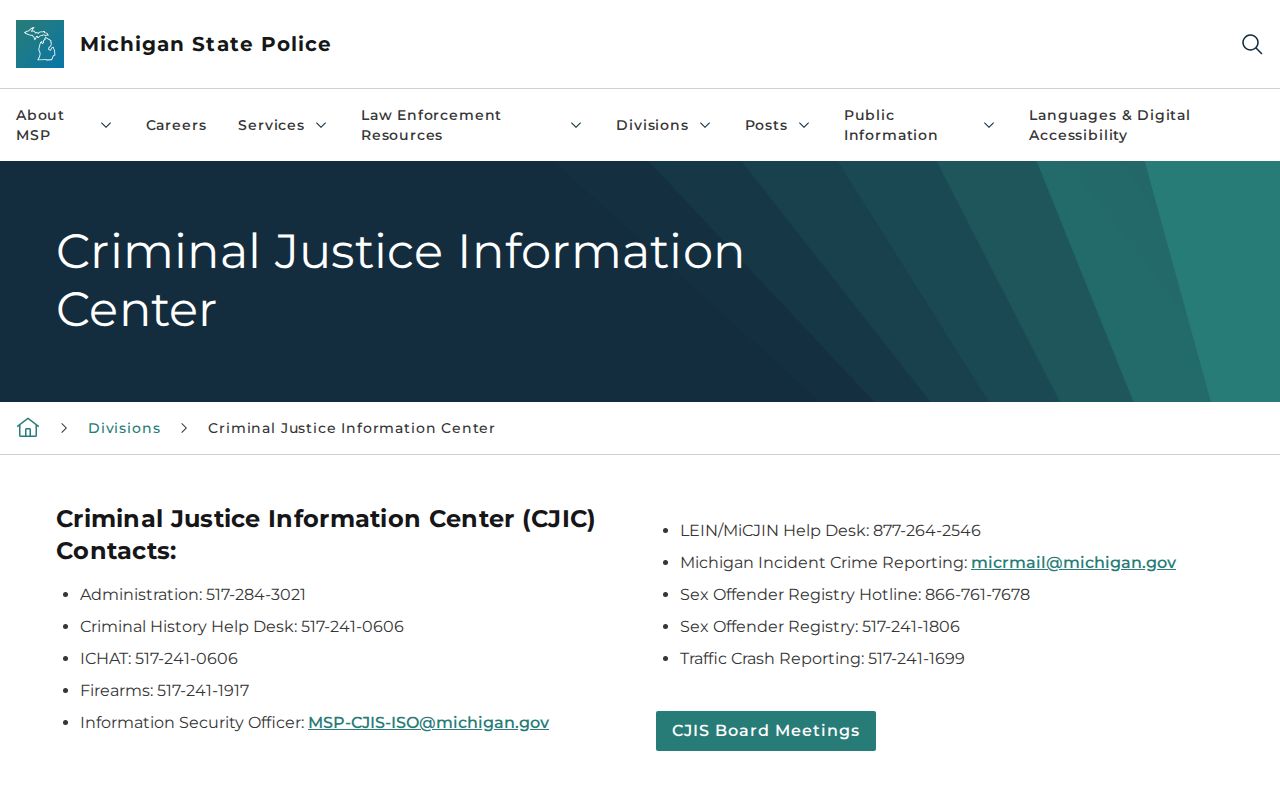
For qualifying offenses, the arresting agency submits fingerprints and arrest information to the Michigan State Police Criminal Justice Information Center. The official fingerprinting route explains Live Scan access for authorized or personal-review uses. Prosecutors and courts report later action, and CJIC associates a disposition with the arrest cycle. Lesser, local, non-fingerprinted, federal, tribal, and out-of-state events fall outside public ICHAT.
The CJIC information page explains the repository’s role.
A person correcting their own record should use fingerprint review and coordinate with the reporting agency, court, and CJIC.
Arrest Records vs Conviction Records
An arrest records a decision to take someone into custody. A conviction requires a guilty or no-contest plea or a guilty verdict followed by judgment. The documents are created by different offices. An arrest may lead to no charge, dismissal, or acquittal, while the agency report can remain subject to its own retention and access rules.
| Arrest Record | Conviction Record |
|---|---|
| Created by the arresting agency and jail | Created by the court after a plea or verdict |
| Shows an arrest and possible booking | Shows a judgment of guilt |
| Held by the agency and sheriff | Held by the clerk and reported to CJIC |
| May end with release or no filed charge | May lead to sentence, appeal, or set-aside |
Note: A Leelanau County arrest is not proof of guilt, and the filed court outcome must be checked before reaching any conclusion.
Leelanau Jail or OTIS
Use the Leelanau jail for current county custody. Switch to OTIS only when a person enters MDOC prison, felony probation, or parole. OTIS excludes county-jail-only cases and people not yet sentenced. It also limits older discharged profiles under its published scope.
For charges and final outcomes, use the Leelanau County court case lookup. Custody systems answer where a person is held or supervised. Court files answer what was charged and how the case ended. Neither product substitutes for the arresting agency’s report.
Dismissed Leelanau Arrest Records
A dismissal ends a filed charge without conviction in that case, but it does not automatically erase every agency record. The arresting office can still hold its incident report, and the jail can still hold the booking episode. Public release remains subject to retention rules, FOIA exemptions, set-aside law, and any order that makes information nonpublic.
Read the court disposition first. Then ask the agency what record remains and what can be released. For a person correcting their own statewide history, fingerprint-based review can help identify an unmatched or missing disposition. Coordinate with the arresting agency, court clerk, and CJIC rather than assuming one office can change every system.
Michigan set-aside law can make an eligible conviction nonpublic, while separate rules can affect non-conviction information. Eligibility depends on the exact record and current statute. Obtain the court file, confirm the charge-level disposition, and use the official Michigan process. Do not rely on an old booking screenshot or an unofficial arrest gallery to describe current legal status.
Agency retention and public access are separate questions. A record can still exist while protected parts remain unavailable. For a crash-related event, MSP’s traffic crash report channel can be a separate source from the arrest report.